STP & RSTP Port States Explained: Blocking vs Forwarding
Port States - Spanning Tree
When all network bridges have all their ports either in a
"blocking" (inactive) or "forwarding" (active) state, the
network is considered converged, meaning it has reached a stable loop-free topology; however, if a network change occurs, the network can become
temporarily unavailable until the bridges recalculate their states and converge
again, with RSTP (a few seconds or less) significantly reducing this downtime compared to the
older STP (tens of seconds) protocol by converging much faster.
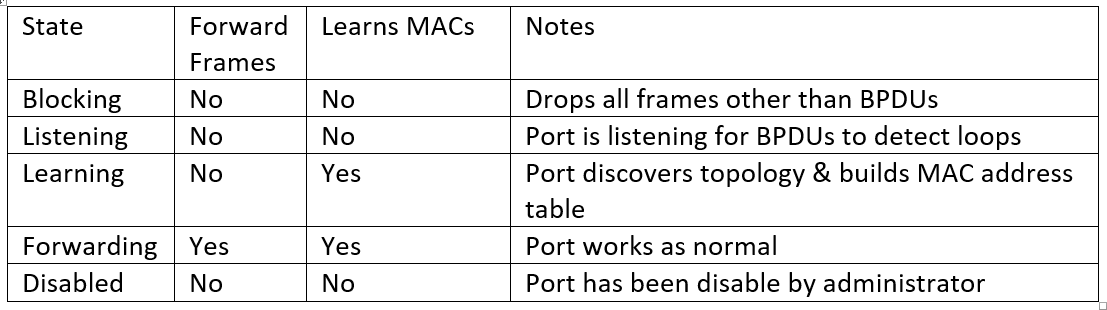
In the original IEEE 802.1D Spanning Tree Protocol (STP), each port moves through five possible states. A port in the "blocking" state doesn't forward traffic but still listens for BPDUs so it can detect topology changes. If it's selected to move toward an active role, it transitions to "listening," where it still doesn't forward frames or learn MAC addresses but begins participating in the election process. Next is "learning," where the port starts building its MAC address table but still withholds frames from the network. Only after passing through these transitional states does a port reach "forwarding," where it actively sends and receives traffic. A port can also be placed in the "disabled" state, meaning it's administratively shut down and takes no part in STP at all. Moving from blocking all the way to forwarding under STP can take up to 50 seconds, since the listening and learning states each last one Forward Delay period (15 seconds by default).
Rapid Spanning Tree Protocol (RSTP) simplifies this by collapsing blocking, listening, and disabled into a single "discarding" state, leaving just three port states overall: discarding, learning, and forwarding. RSTP also replaces STP's fixed timers with an active handshake (the proposal/agreement process) between switches, plus defined port roles like alternate and backup that let a switch pre-calculate a replacement path before a failure even happens, which is why RSTP typically converges in a few seconds or less, compared to STP's up to 50 seconds.
Exam Tip: Network+ loves to test the order of STP port states and what each one actually does. Remember the progression as Blocking → Listening → Learning → Forwarding, and keep in mind that only Learning and Forwarding build the MAC address table, while only Forwarding actually passes user traffic. For RSTP, just remember it collapses that same idea down to three states: Discarding → Learning → Forwarding.
Comments
Post a Comment